concepts · updated 2026-08-01
Gravity Engines and the Diving Engine
confidence: medium volatility: cold verified: 2026-08-01fresh
Steve Baer's 1974 CoEvolution Quarterly article surveying gravity-driven heat engines and presenting his own regenerator-based 'diving engine' — a Stirling/Ericsson-adjacent design using buoyant divers in hot/cold liquid baths, with a Carnot feasibility calculation and a working prototype.
A gravity engine, in Steve Baer’s definition, is one that relies on gravity to function — not a perpetual-motion machine, any more than a flywheel- or spring-driven engine is one. Hydroelectric plants, waterwheels, and windmills all qualify. Gravity acts as a spring that “doesn’t wear out… an energy bank that can’t be robbed.” Baer laid out this idea, surveyed several historical gravity-engine designs, and presented his own invention — the diving engine — in a 1974 article for The CoEvolution Quarterly.
Historical designs surveyed
While researching prior art at the US Patent Office in 1973, Baer traced a recurring device: a wheel of paired sealed chambers, heated at the bottom of each revolution and cooled at the top, whose internal vapor-pressure imbalance drives liquid between chambers and turns the wheel “like a water wheel which supplies itself with its own water.” The earliest version he found was A. & A. Iske’s 1882 patent (US 256,482); the most recent reinvention was US 3,659,416 (1972). He judged the design fundamentally inefficient, since the same container must serve as both boiler and condenser every cycle, and drew a contrast with the dipping-bird toy, whose separate dedicated boiler and condenser avoid that waste.
Two further 19th/20th-century patents (O.C. Spofford; George O. Schur) used a related bubble-wheel-in-a-heated-bath design with the same core flaw. Baer sketched his own refinements: a two-liquid bubble wheel (using immiscible liquids of different boiling points to control where boiling occurs) and an eduction pump variant reconfigured for forced circulation rather than rotation — which he suggested “could be useful in solar heating systems that require forced circulation.”
The diving engine
Baer’s own design replaces the bubble-in-a-wheel with two weighted floats (“divers”) suspended in separate hot and cold liquid baths and connected to a flywheel. Air trapped between the divers passes back and forth through a regenerator — a thermal-storage element that captures heat/moisture from air moving toward the cold side and returns it on the way back — as the flywheel turns. The differential buoyancy between the warmer, larger air pocket on the hot side and the cooler, smaller one on the cold side is the engine’s source of work.
Baer explicitly positions the design relative to known engine types: like a Stirling engine, gas passes between hot and cold pistons through a regenerator, but where the Stirling engine cages gas at constant volume, Baer’s diving engine operates the gas at roughly constant pressure (unconfined beyond gravity) — closer to the less-common Ericsson engine cycle, with the added complication of an evaporating/condensing liquid exaggerating the buoyancy swing.
Feasibility and prototype
A Carnot-bound calculation (2000 Btu/ft² daily solar input, realistic winter/summer hot-cold tank temperature pairs) found no thermodynamic obstacle to extracting useful mechanical power at plausible engine dimensions (bubbles tens of inches deep, moving fractions of a foot per second) — though drag through the liquid baths and mechanical couplings roughly doubles the practical power requirement above the idealized figure.
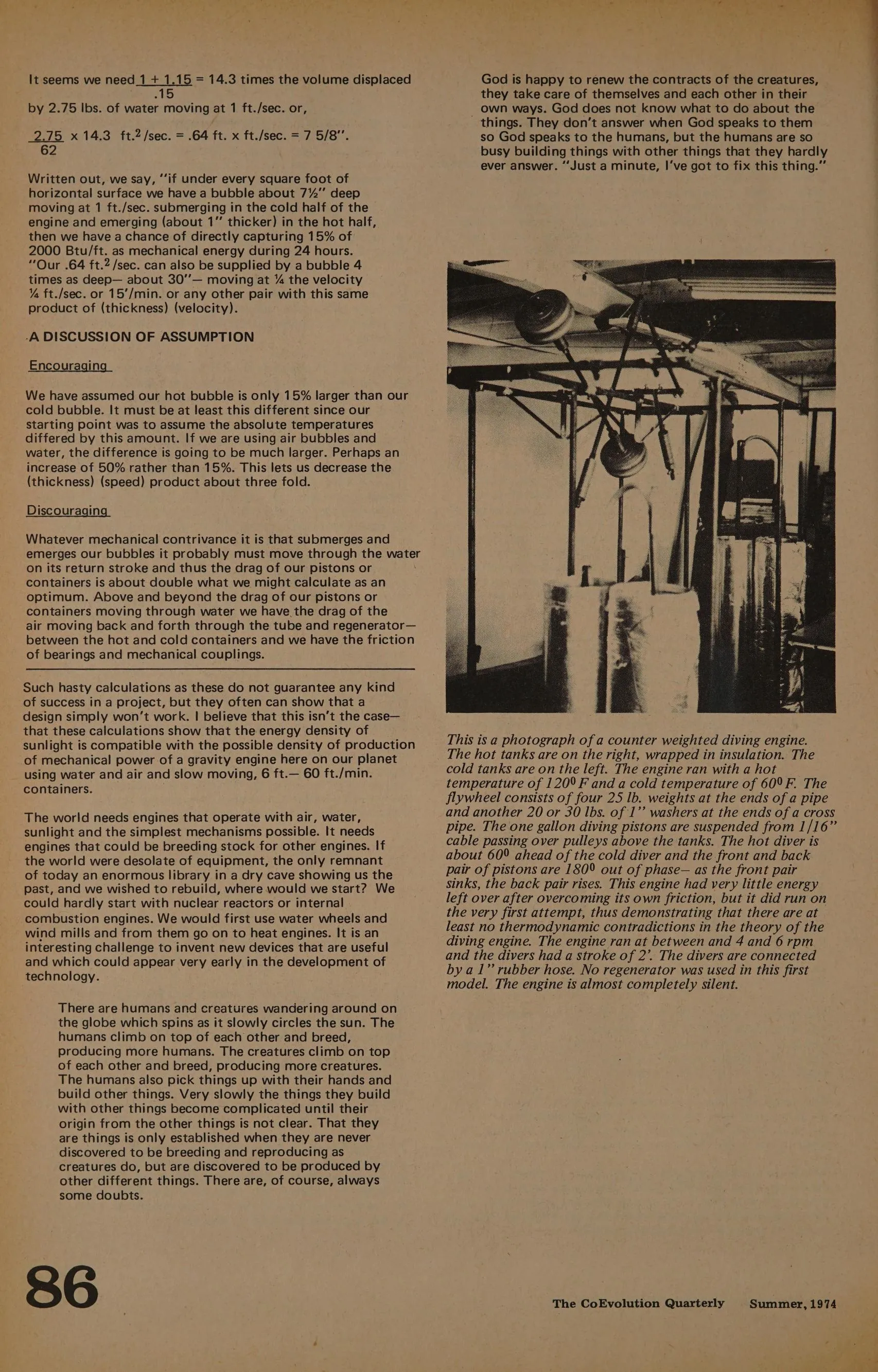
Baer built and tested a counterweighted diving engine prototype: 1-gallon diving pistons on 1/16” cable over pulleys, a flywheel made of four 25 lb weights plus 20–30 lbs of 1” washers, hot bath at 120°F and cold bath at 60°F, running at 4–6 rpm with a 2-foot stroke, no regenerator on this first model. It ran on the first attempt — with little power to spare after overcoming its own friction, but enough to demonstrate “at least no thermodynamic contradictions in the theory of the diving engine.” Baer describes it as “almost completely silent.”
Why it matters in the archive
This article is the fuller, dedicated treatment of the gravity-engine/diving-engine idea that Sunspots (1975) later condenses into a single paragraph (Ch. 9.9) as the archive’s first explicit description of building cooling by convection. The same air-loop, regenerator-adjacent thinking underlies the thermosiphon cooling later formalized in the Cool Cell product line, and the patent-office research here — an Iske-engine lineage running from 1882 to a 1972 reinvention — is characteristic of Baer’s habit of grounding his own inventions in a documented history of prior attempts.
See also
- Sunspots: Collected Facts and Solar Fiction — Ch. 9.9 condenses this same material a year later
- Thermosiphon — the later, formalized descendant of this convective-cooling principle
- Steve Baer
- Zomeworks Corporation
- Zomeworks patent portfolio