concepts · updated 2026-08-01
Sunspots: Collected Facts and Solar Fiction
confidence: high volatility: cold verified: 2026-08-01fresh
Steve Baer — Zomeworks Corporation, Albuquerque, New Mexico — June 1975* Illustrated by Criss-Cross Art Workshop. Library of Congress: 75-20779. Dedicated to Theodore Baird.
Steve Baer — Zomeworks Corporation, Albuquerque, New Mexico — June 1975 Illustrated by Criss-Cross Art Workshop. Library of Congress: 75-20779. Dedicated to Theodore Baird.
Baer’s third book, after Dome Cookbook (1968, Lama Foundation, out of print by 1975) and Zome Primer (1970, Zomeworks). Eleven chapters mixing factual solar science with interleaved solar fiction — the fiction pieces are titled distinctly and set in italics in the original. It is the earliest dense primary source in the archive.
Editions: The archive holds the 1975 first edition (Zomeworks Corporation, subtitle “Collected Facts and Solar Fiction”). A 1977 Zomeworks Corp. printing (same subtitle) is confirmed by the LBL Appropriate Energy Technology Library Bibliography (Hannah R. Clark, August 1979, LBL-9391) — placed in the DOE-funded AET library before the Cloudburst reissue. Page count discrepancy: LBL cites 146 pages; a physical copy in the Joule Heist collection is 115 pages. Possible causes: different printings, incomplete copy, or differing counting conventions. A second edition was published in 1979 by Cloudburst Press (ISBN 0-88930-061-3 per the physical copy catalogued in the Joule Heist collection; Nick Pine’s 1995 post prints it as 0-88930-062-3, likely a transcription error; subtitle “An Exploration of Solar Energy Through Fact and Fiction”, 127 pages) — in collection, not yet ingested. Nick Pine’s 1995 Usenet post quotes pp. 62–66 on Air Loop Rock Storage Systems from this edition. The 19-page difference between the 1977 Zomeworks printing (146pp) and the 1979 Cloudburst edition (127pp) indicates content was reorganized or cut; which material differs is unknown until both are compared.
What it contains
Technical material
Chapter 1 — The Sun: Orbital mechanics for builders. Earth is closest to the sun in January (91,350,000 miles) and farthest in July (94,455,000 miles) — 3.4% difference, ~7% intensity variation. Earth spends 186 days in the Northern Hemisphere, 179 in the Southern. Orientation table: heat interception at 0°=100%, 25°=90.6%, 45°=70.7%. The Antarctic heat collector calculation appears here first — a south wall in Albuquerque is parallel to the horizon at a point 700 miles north of the Antarctic.
Chapter 2 — Energy: Analogies as pedagogy. A car crash at 60 mph = 311 BTU = one solar hour per square foot. Boulder Dam is not tall enough to warm its water 1°F on impact. A 3×4 ft south-facing window admits as much energy per winter day as the food needed to feed a man (12,000 BTU/day). These images recur in the 1973 Tribal Messenger serialization.
Chapter 3 — Basic Technology: Ice ranch proposal — at least 6 feet of ice per year can be harvested from Albuquerque ponds; $0.01/lb ice from ponds vs. $0.15/100 lbs electrically produced. Yis-sol pump, demonstrated at the 1968 Solar Energy Convention — a solar-powered pump similar to Savery steam engines, exploiting liquids with different thermodynamic properties.
Chapter 4 — Bubbles, Water, Heat Pipes: Baer’s play with soap-bubble geometry (foams meeting in “a forest of perfect 120° angles”) leads to a bubble solar collector and bubble-tray experiments. Section 4.7, the Stock Pond Melter, documents the closed-loop convective device Baer built to keep stock-pond water from freezing — the conceptual seed of the double-play thermosiphon (the 2025 Kayatekin paper traces the loop’s origin to this late-1960s melter). Section 4.8 sketches “a new kind of heat pipe.”
Chapter 5 — Heat Exchangers: counterflow heat-exchanger pedagogy via the scrapyard — “there is no better place to educate yourself in the matter of heat exchangers than a junkyard” — with how heat conducts and moves.
Chapter 6 — Heat Collectors and Houses: the earth itself as the original heat collector; window and skylight efficiency; and the design rules repeated across the archive — a south window of about 1/5 the floor area suffices for Albuquerque, and floors should be brick, concrete, mud, or tile (never carpet) to store heat. Two celebrated sections here are factual, not fiction:
- The Beadwall (6.5): Invented by Dave Harrison (patent applied for). Styrofoam beads blown between window panes by an ordinary vacuum cleaner; insulation value adjustable by bead-layer thickness. “Such elegant inventions as the beadwall indicate that the healthy response of architecture to increasing energy costs may be increased use of glass in building walls rather than a retreat to underground buildings.” The Monte Vista Beadwall Greenhouse installation is documented.
- Reptiles need mammal houses (6.9): Thermostat-regulated houses are “Reptile Technology.” The reptile cannot regulate its own body temperature and badly needs it; the mammal does not.
Chapter 7 — Flat Plate Collectors: swimming-pool heaters as the cheapest flat-plate collectors; collector comparisons; “heat collectors must be awakened in the morning” (warm-up lag); sacrificed heat; and selective surfaces for trapping sunlight.
Chapter 8 — Air Loop Rock Storage Systems: convective, fan-free air-loop rock storage and solar chimneys. At a 1968 conference Farrington Daniels relayed reports of a New Mexican pushing air through rock bins with solar chimneys — an engineer in the audience insisted the chimneys “would have to be as tall as the Empire State Building”; Baer was “very pleased to report” on the just-completed Drop City heater, whose chimney was only 14 feet high. This is the air-based storage lineage behind the Paul Davis air-loop rock-storage house, and the chapter (pp. 62–66 in the 1979 edition) Nick Pine later quoted.
Chapter 9 — Engines: Gravity engines (not perpetual motion — they use gravity as a spring). The diving engine: air pistons in water with a regenerator, low temperatures (under 160°F), easy repair. Published in Coevolution Quarterly, Summer 1974 — see Gravity Engines and the Diving Engine for the fuller, dedicated treatment (patent research, historical designs, feasibility calculation, and the built prototype). Section 9.9 is the archive’s first explicit description of building cooling by convection:
A house is a shade sandwich — the roof on one side, the earth on the other. Loop of tubing through house and onto roof, filled with liquid. At night after roof cools below interior temperature, convection begins: house gives heat to fluid, fluid rises to roof, radiates to sky, returns cooled. A combination engine-refrigerator.
This is the thermosiphon in embryo — 27 years before the Cool Cell brochure formalized it. Section 9.10 describes “reverse juices” (water below 39°F sinks when heated) as a freeze-prevention mechanism for collectors.
Chapter 10 — Skylids: The first full technical documentation of the Skylid — US Patent 3,884,414. Full specifications: 22” louvers, Refrigerant 12 canisters (2½” × 16½”), R factor ~5, opens 95% of Albuquerque winter days. DrumWall data: each drum holds 450 lbs of water. Outside reflectors: a simple aluminum reflector increases solar gain by more than 30% at no additional glazing cost. Nightwall: rigid foam pressed directly against windows, cheaper than Skylids, automatable using the same canister principle.
Chapter 11 — Solar Energy Conferences: Firsthand accounts. First solar conference: Palo Alto, October 1968, ~65 people. 1973 Washington DC NSF meeting: Harry Thomason (three solar houses at $1-2/sq ft) was kept in the audience while Alcoa and Texas Instruments sat at the table. Industry comment: “The worst thing in the world to do would be to rush ahead and build solar houses prematurely—before all the bugs are worked out.”
NSF grant success for Zomeworks: “0 — actually less than 0 figuring the time wasted writing proposals.” Two metaphors that reappear in Sunmen and the archive’s recurring policy argument:
- Solar Insecticide: NSF grants are like releasing sterile male insects — they crowd out the fertile ones.
- Solar Vaccination: Government money is “a vaccination against the full-blown disease of solar energy utilization.” Active immune state prevents the real epidemic.
Policy recommendation: “Let the government promise to buy, at a high price, power from new power generating stations that use solar, wind, tides, and geothermal energy.” Promise a market; don’t subsidize research.
Fiction pieces
Six titled fiction pieces across the eleven chapters (plus an italicized aside, 2.14 “Retrieving Mechanical Energy,” on the one-way tax that thermodynamics levies when mechanical energy is recovered from heat):
- Shadows: Helicopters deploy shrouds to shade the homes of dissidents going solar.
- The Sun Riots: A crowd uses foot-square mirrors to focus sunlight on a police car. “Give ‘em some sunshine.” — In November 2011, The Atlantic’s Alexis C. Madrigal quoted this piece in full during the Occupy Wall Street protests, calling it “a strange mix of metaphorical energy policy statement and protest fiction.” First known appearance of Baer’s solar fiction in major national media.
- Portrait of a Gasoline Drinker: A gas station attendant secretly drinks from customer tanks.
- The Baskers: A sun oil enabling photosynthesis spawns migration to the Southwest; later found to cause sterility, shipped to “underdeveloped countries” as population control.
- The Sun Tax: An organization claims a percentage of all sunshine collected and demands payment.
- The Garbage Can: “Trojan Solar Equipment” — old Ralph and Gene, fixtures at solar conferences, force the solar society into a collector race: Trojan vs. “several of the nation’s largest weapons contractors.”
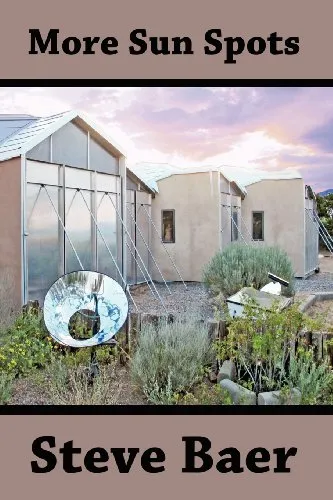
Later work: More Sun Spots (2012)
Baer produced a follow-up volume, More Sun Spots (2012), decades after the original. Only the cover has been ingested so far — no page content is yet in the archive.
Why it matters in the archive
Sunspots is the bridge between Baer’s counterculture geometry work (zomes, 1968–1970) and his thermal engineering period (Cool Cell, 1999–2004). Written before any of the archive’s main engineering sources, it establishes the voice, the analogies, and the policy stance that run through the entire body of work. The gravity engine / convection cooling passage (9.9) is the conceptual origin of the thermosiphon cooling that the 2002 Cool Cell brochure describes as a product. The NSF critique prefigures the Sunmen manifesto by 29 years.
It is also the primary source for the Skylid technical specifications and the DrumWall drum weight.
See also
- Nick Pine
- Steve Baer
- Gravity Engines and the Diving Engine
- Skylid
- DrumWall
- Thermosiphon
- Steve Baer and the double-play thermosiphon
- Double plays old and new
- Consider perihelion
- Antarctic heat collector
- Sunmen
- Tribal Messenger solar serialization
- Beadwall
- Sunbender
- Harold Hay
- Bibliography
- Dave Harrison
- Harry Thomason
- Books
- Dome Cookbook — Baer’s first book (1968), out of print by the time Sunspots appeared
- 1973 NSF solar meeting — the Washington DC meeting recounted firsthand in Chapter 11
- Monte Vista School — site of the Monte Vista Beadwall Greenhouse photographed in the book