Double Play Container Slideshow — Draft Deck
Double Play
A building that heats and cools itself
A first-pass script for the display that would live inside the Double Play container — a draft answer to the team's brief: index-navigable, otherwise auto-advancing, telling the story through Steve Baer's history, how it works, why it matters now, and where someone could get one.
How this display would work
- Index screen: one entry per section (Timeline, How It Works, Why Now, Future, Where Do I Get One) — tap to jump straight there
- Autoplay: ~12–15 sec/slide by default, loops back to the title slide
- Manual override: touch/arrow "next"/"back" pauses autoplay; resumes after ~90s idle
- Standard kiosk pattern — Marp (this deck) exported to images, or any looping HTML/JS slideshow. No new infrastructure needed.
This deck is a content script, not final visual design — a draft to cut down once screen size and viewing distance inside the container are known.
A building that heats and cools itself
- Invented by Steve Baer, Corrales & Albuquerque, New Mexico
- No compressor. No refrigerant. In its first version, not even a fan.
- You are standing inside a working example.
Timeline: 1958 – 2026
Five phases, one continuous idea. Tap ahead to any phase.
Phase 1 — The physics was already known
1958–1964
- 1958: Yanagimachi proposes combining solar heat, night-sky cooling, and a radiant panel into one system — on paper, in Tucson
- 1961: Bliss demonstrates it for real in Arizona — a 280 ft² black cloth radiator and 10 tons of rock make 2 tons of refrigeration, no power
- 1964: Farrington Daniels writes it up in Direct Use of the Sun's Energy
- Nobody had built it into a building yet — that came next
Phase 2 — Steve builds the first one
1967–1971, Drop City
- At the counterculture commune Drop City, Baer builds what he later calls, on camera, "the first convective air loop rock storage system that worked, that I know of"
- 1969: Baer files two patents the same day — an osmotic heat pipe, and a stock-pond de-icer for cattle water
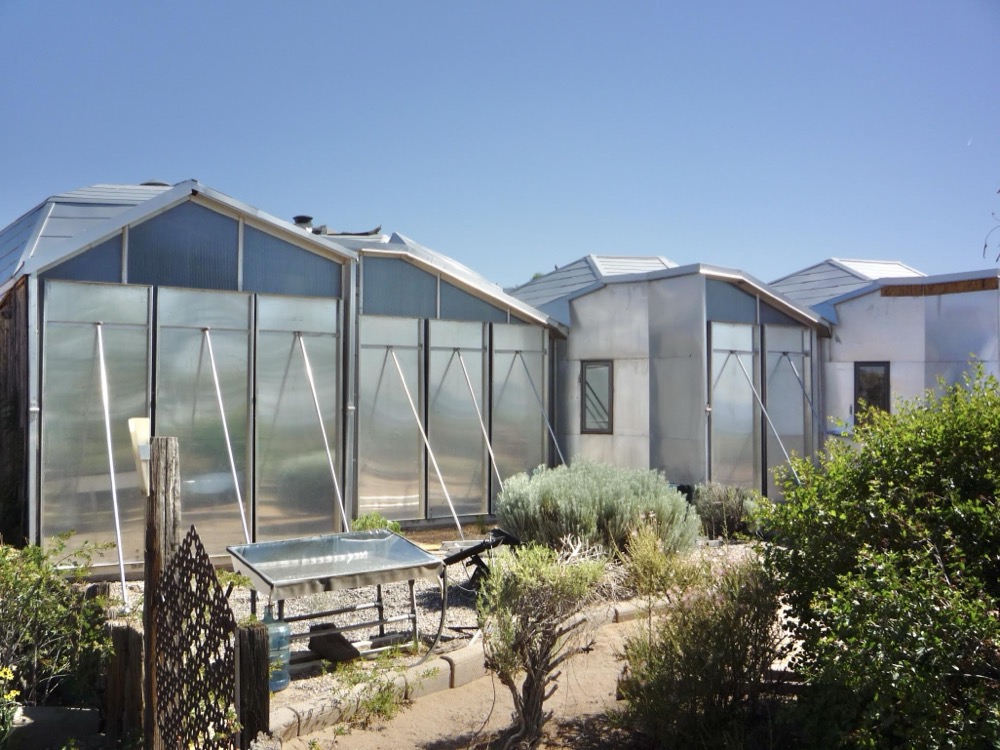
- 1971: The Baer House in Corrales — the first full integration of solar collection, water thermal mass, and movable insulation in a real home
Phase 3 — Teaching it to everyone
1973, Tribal Messenger
- Baer explains the physics using junkyards, car crashes, and rock bins — not equations
- The idea: make radiant energy felt, not just calculated
- This teaching method is still the best way to explain the container to a first-time visitor (see the "How It Works" section)
Phase 4 — Selling it
1990–2002
- 1990–94: Zomeworks sells thousands of passively-cooled cabinets to telephone companies for outdoor battery equipment — same physics, proven at commercial scale, largely unnoticed
- 2002: The same idea becomes an architectural product — Cool Cell and di-thermal roofs — water in the building's skin instead of a separate box
Phase 5 — The world catches up
2025
- A peer-reviewed history-of-technology paper (Cem Kayatekin, ICON, 2025) confirms: the double-play thermosiphon was Baer's central, most overlooked contribution — not a side project
- Baer died in May 2024, one year before the paper that said his real work hadn't been recognized yet
Today — the container you're standing in
2026
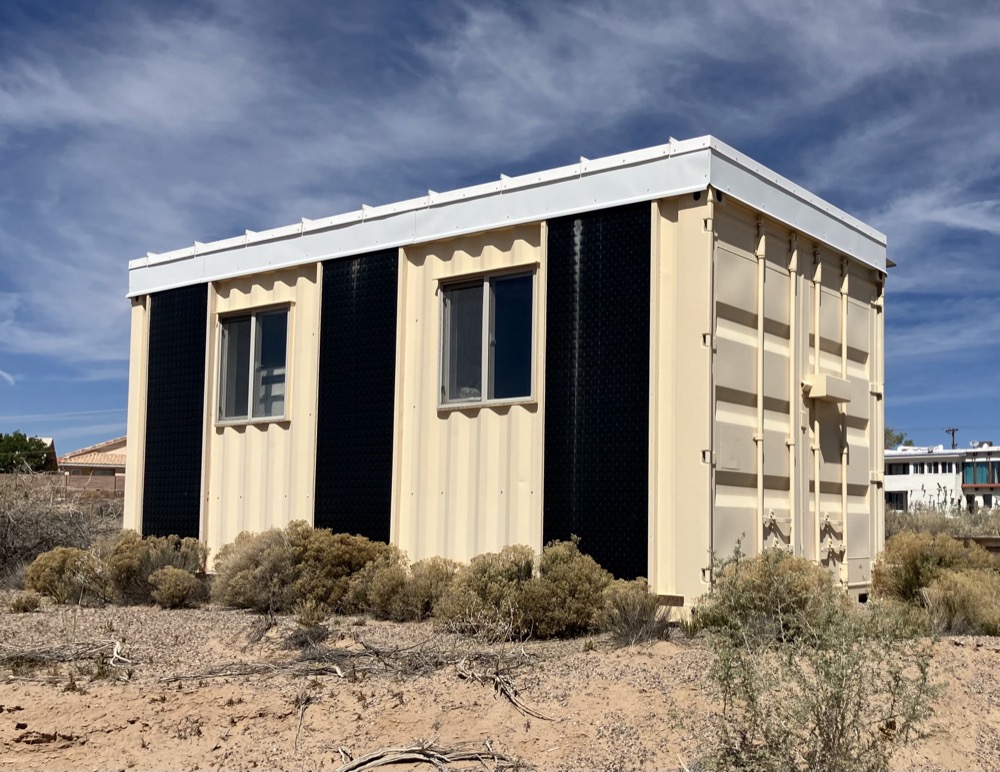
- A Zomeworks engineering team builds a Double Play inside a standard shipping container — the same physics, in a form that can be trucked somewhere and set down
- This is the newest chapter of a 68-year-old idea, and the first one built to be moved, not just built
How It Works
Four short slides. The physics is old, honest, and easy to show a fourth-grader.
The one idea underneath everything
- Water holds heat about 3,500× more effectively than air — that's why the whole system can be small, quiet, and pump-free
- The night sky is cold — even on a warm night, a surface facing straight up radiates its heat out into space and gets colder than the air around it
- Baer's trick: connect a water tank to a roof panel, and let the water itself decide when to collect heat and when to dump it
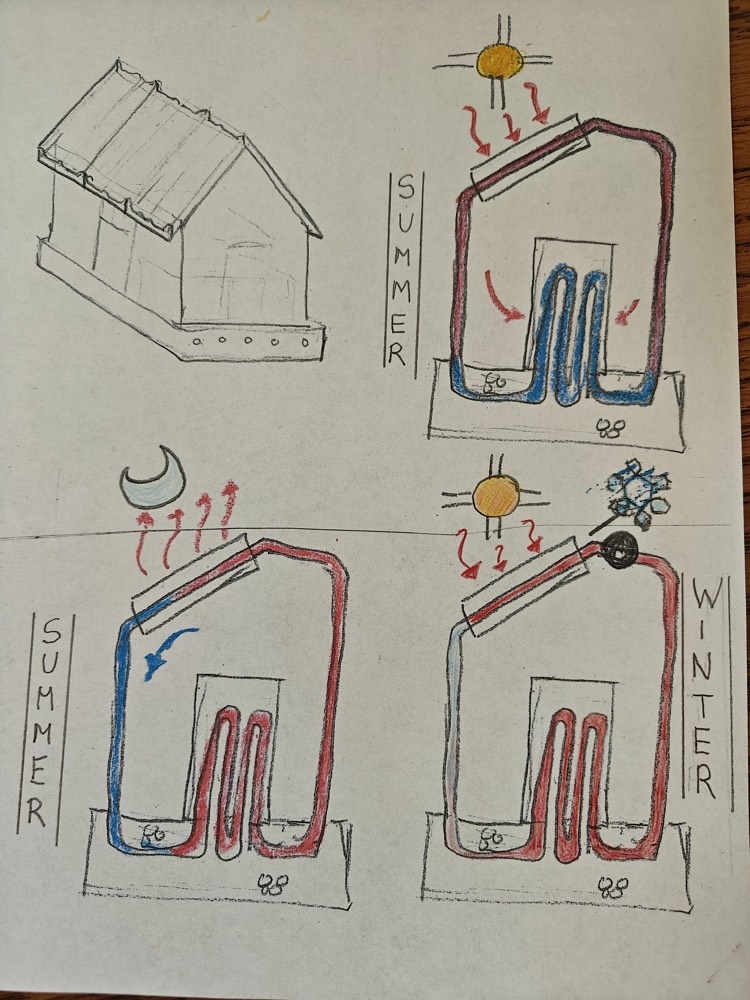
Summer — how it cools
- Day: water stored in the ceiling soaks up heat from the room, like a sponge
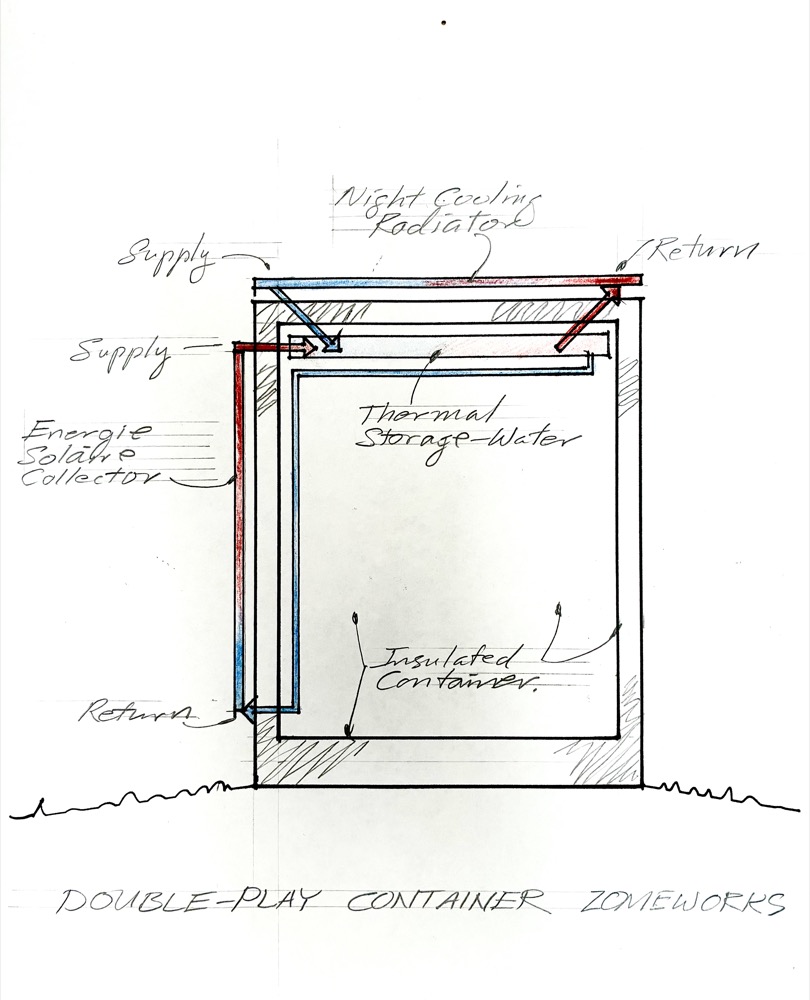
- Night: the roof panel, now cooler than the water, lets that stored heat radiate out to the night sky — no fan, no pump, water moves on its own by natural convection (a thermosiphon)
- Wake up to a cool room, every day, powered by nothing but the sky
Winter — how it heats
- A small pump (or, on the south wall, no pump at all) circulates water through the same roof panel while the sun is out
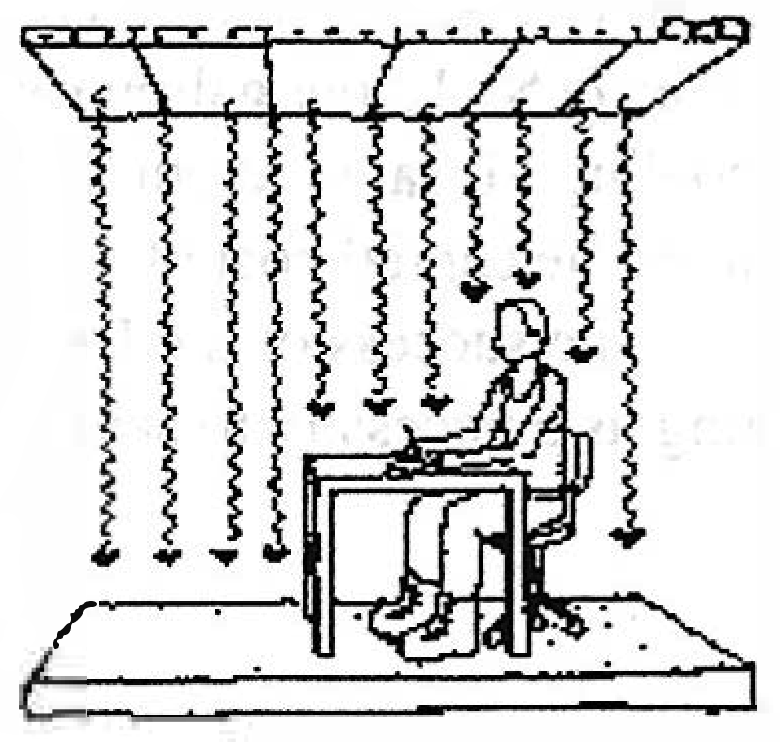
- Aluminum louvers open to let that stored warmth radiate down into the room
- Close the louvers and the heat stays put — you control when it comes in
This container's loop
- Solar collector → thermal storage water → night-cooling roof radiator → back to storage → back to collector
- One closed loop does both jobs, season to season
- Nearly nothing to break: no compressor, no refrigerant, no electronics required to keep working
In Steve's own words
"My name is Steve Baer. I'm first and foremost an inventor, trying to figure out how to make buildings that heat and cool themselves, how to heat water without having to burn anything using the sun."
— on camera, Drop City documentary (c. 2002)
Why This Matters Right Now
It works when the grid doesn't
- No compressor, no fan required to keep working — the building keeps its temperature through a power outage
- For a hot New Mexico summer with an aging grid, that isn't a footnote, it's the headline
- Independent field data (NSRC, New Mexico climate zones): 25–89% power savings versus conventional cooling
The economics already pencil out
- Zomeworks' own brochure figures: roughly $3.50/ft²/year in avoided energy cost for a Cool Cell building, plus no compressor to buy or replace
- The physics has been independently validated by government engineers, practicing architects, and now an academic historian
- So why isn't this everywhere already? No recurring revenue for the utilities and HVAC makers who'd normally sell you a solution — a passive system doesn't send anyone a monthly bill. That's a business-model gap, not a physics gap. (See "Where Do I Get One" for what closes that gap.)
Future Applications
From custom building to shippable product
- Every earlier chapter of this story was a one-off, site-built structure — a house, a studio, a test shed
- The container prototype is the first version built to be standardized and relocatable — closer to a product than a building
- That single shift — building to shipped object — is what could let this scale beyond one architect's back yard at a time
Thermal-as-a-Service — a possible business model
- The model that made rooftop solar panels common wasn't better panels — it was the solar lease/PPA: someone else owns the hardware, you just pay a monthly bill that's lower than your old one
- Applied here: a provider installs and owns a Double Play unit, the building owner pays a fee below their current cooling bill, the provider keeps the margin and can redeploy the container if the deal ends
Why this system fits that model well
- Near-zero operating cost + decades-long lifespan + a relocatable box make this system an unusually good candidate for that model
- Open problems: metering thermal output (there's no "kWh produced" meter yet) and what happens when a building changes hands
"That's great — where do I get one?"
The honest answer today
- There is no catalog, no dealer, and no price list yet. This is not a finished consumer product — it's a working prototype with a 68-year paper trail behind it
- But one specific unit already exists and is for sale: this exact kind of shipping-container Double Play, from the Baer family (Jose Baer, Steve's son and estate executor) — see the companion proposal, The Double Play at Los Ranchos, now in front of the Village of Los Ranchos de Albuquerque
The path from prototype to product
- The path from "one prototype" to "you can buy one" most likely runs through the Thermal-as-a-Service model on the previous slide — a provider who owns and places units, rather than a factory selling finished boxes direct to homeowners
- What would speed this up: a funded, monitored public installation (like the one being proposed at Los Ranchos) that proves cost and comfort numbers in front of the people who'd need to believe them — grant funders, future partners, the Village itself
What we're asking visitors to do
- Take the "how it works" idea seriously — it's simpler than it looks
- If you represent a site, an institution, or a funder: talk to us about hosting the next one
- If you have footage, photos, or stories of Steve explaining this in his own words — see the note on the next slide
A request to Solar Fool members
- We're building a tagged media library of images, video, and audio to draw from when this slideshow gets built for real
- Known video: the 2002 Drop City documentary has ~78 minutes of footage including Steve on camera, transcribed in the archive already
- Known slide deck: Steve's own 2009 AIA talk ("Some Passive Solar Buildings with a Focus on Projects in New Mexico") is already archived, slide-by-slide
- Still wanted: any other video or audio of Steve talking about Double Play, Cool Cell, or di-thermal roofs specifically — send it in and it goes in the archive, tagged for this project
Sources & credits
- Steve Baer / Zomeworks archive — kb.solarfool.org
- Evolution of the thermal vision · Why hasn't passive thermal scaled? · Thermal-as-a-service · Explaining radiant energy to laypeople
- Cool Cell architectural climate-control · Di-thermal roofs · Steve Baer and the double-play thermosiphon · Zomeworks shipping container prototype
- Kayatekin, ICON: Journal of the International Committee for the History of Technology, 2025
- Drop City documentary (c. 2002, dir. probably Joan Grossman)
- Companion: The Double Play at Los Ranchos board proposal