concepts · updated 2026-08-01
Di-thermal roofs
confidence: high volatility: cold verified: 2026-08-01fresh
Di-thermal roofs are Zomeworks' unglazed radiator/absorbers that do double duty: collect solar heat during winter days and reject heat to the night sky on summer nights. In some cases the same roof bo
Di-thermal roofs are Zomeworks’ unglazed radiator/absorbers that do double duty: collect solar heat during winter days and reject heat to the night sky on summer nights. In some cases the same roof both collects and rejects heat within the same 24-hour period. The brochure claims: “The Di-thermal roof allows one to do all the cooling and most of the heating in many parts of the United States.”
Construction variants
Three forms are proposed:
- Blow-molded plastic — similar to swimming pool collector mats
- Aluminum extrusion with snap-in copper pipes — the form later developed as the Double Play roll-formed panel (see Dear shareholders)
- Copper roof with copper pipe waterways
All three plumb to heat storage tanks and indoor radiant heat exchangers operating at low temperature differences.
Flowing storage, not static mass
The companion essay “Di Thermal Cool Cell Systems — Part of Passive Solar” (June 2002) states the conceptual advance: classic passive solar (insulation, windows, slab floors and masonry mass) succeeded because it was simple, but its storage is static. The di-thermal system adds a large unglazed radiator/absorber and, crucially, “the thermal storage is made to flow rather than remain static. This makes a dramatic difference in the performance of houses, particularly in cooling.”
Cooling is the hard problem: “Insulation alone can’t keep you cool,” and ventilation with night air is “a marginal way to cool” — the air cools only after the earth’s surface has, lags behind it, and carries little heat away from interior walls. (Baer had measured this directly in his 1984 SUNPAPER essay “Cooling with Night Air”: his own house’s drum-mass rooms were “miserably underventilated” on still nights, and natural convection alone proved insufficient for most rooms.) Harry Thomason and Harold Hay built houses in the 1950s and 60s that radiated heat directly to the night sky: “This must be repeated. The house must be first to lose heat; the house can’t wait in line behind the atmosphere.” A radiator with flowing storage “is able to turn the house inside out, to have the house cool on its own roof.”
The water-versus-air numbers: flowing water carries heat about 4,000 times better than air — 1,000 cubic feet of air, an entire roomful, holds the same heat as 2 gallons of water. Why don’t such systems exist yet? “Perhaps it is because we have been shy about plastic taking its rightful place in our buildings.”
Cost targets (2002)
| Component | Target cost |
|---|---|
| Roof (above normal roof cost) | $3.00/ft² |
| Water storage (at 3 gal/ft²) | $1.00/gal = $3.00/ft² |
| Indoor radiant system | The “great question” — can it work at di-thermal temperature ranges and be comfortable enough? |
Annual savings estimate: 40,000–100,000 BTU/ft²/year of heat. Against $0.10/kWh electric heating, that saves $1.20–$3.00/ft²/year (with propane at $1.10/gallon, savings are half as great). Cooling saves ~2 kWh/ft²/year ($0.20/ft²/year) but more importantly replaces the capital cost of a compressor.
The comfort argument
Baer argues the system will succeed only if radiant comfort is so attractive that “customers might choose it for their buildings even if they had to pay high prices for the energy used to run it.” He quotes extensively from Ed Allen’s How Buildings Work (Oxford, 1995) comparing floor and ceiling radiant systems:
- Floor systems warm the feet but cast infrared shadows under tables, cannot heat enough in cold climates without uncomfortable foot temperatures, are degraded by rugs, react slowly, and are expensive to repair.
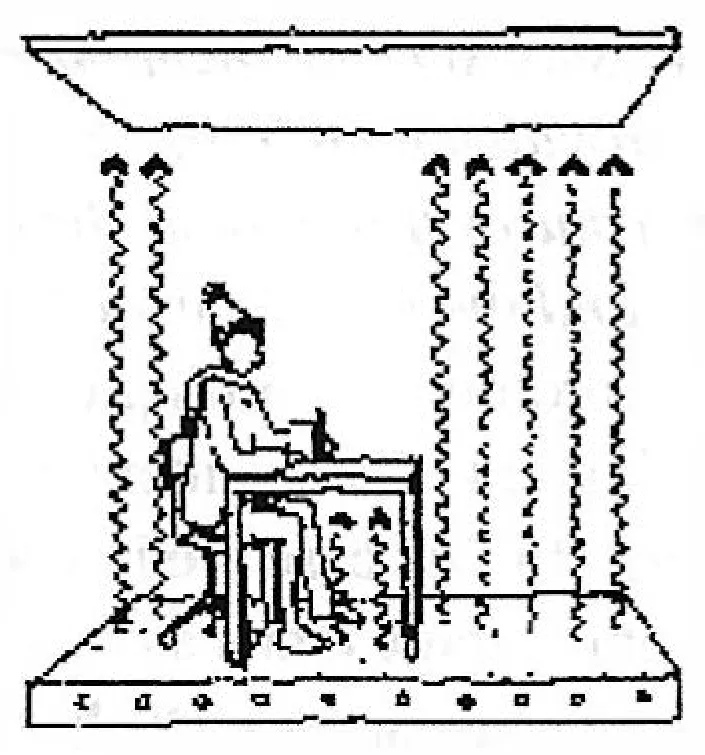
Fig. 9.6 — Tables and desks cast infrared shadows that hamper floor heating systems’ ability to warm hands and arms. (Ed Allen, How Buildings Work, Oxford, 1995)
- Ceiling systems can run at higher temperatures (people rarely touch ceilings), react faster, and are easier to repair. Their weakness is poor downward convection and cool air at floor level.
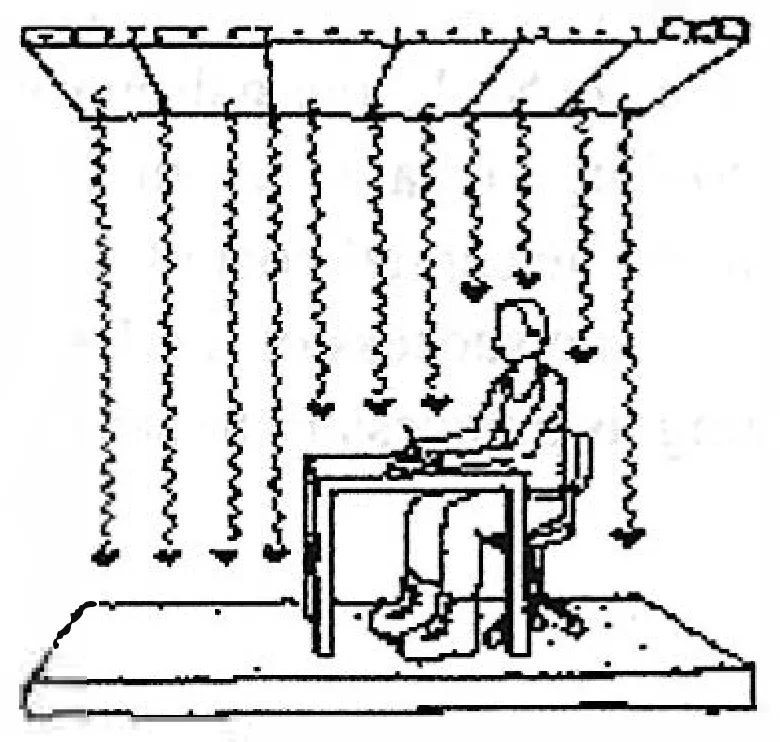
Fig. 9.7 — Downward convection from a warm ceiling is poor, and tables cast infrared shadows on legs and feet. (Ed Allen, How Buildings Work, Oxford, 1995)
- High-temperature infrared sources with focusing reflectors are highly effective, especially where maintaining high air temperatures is impractical.
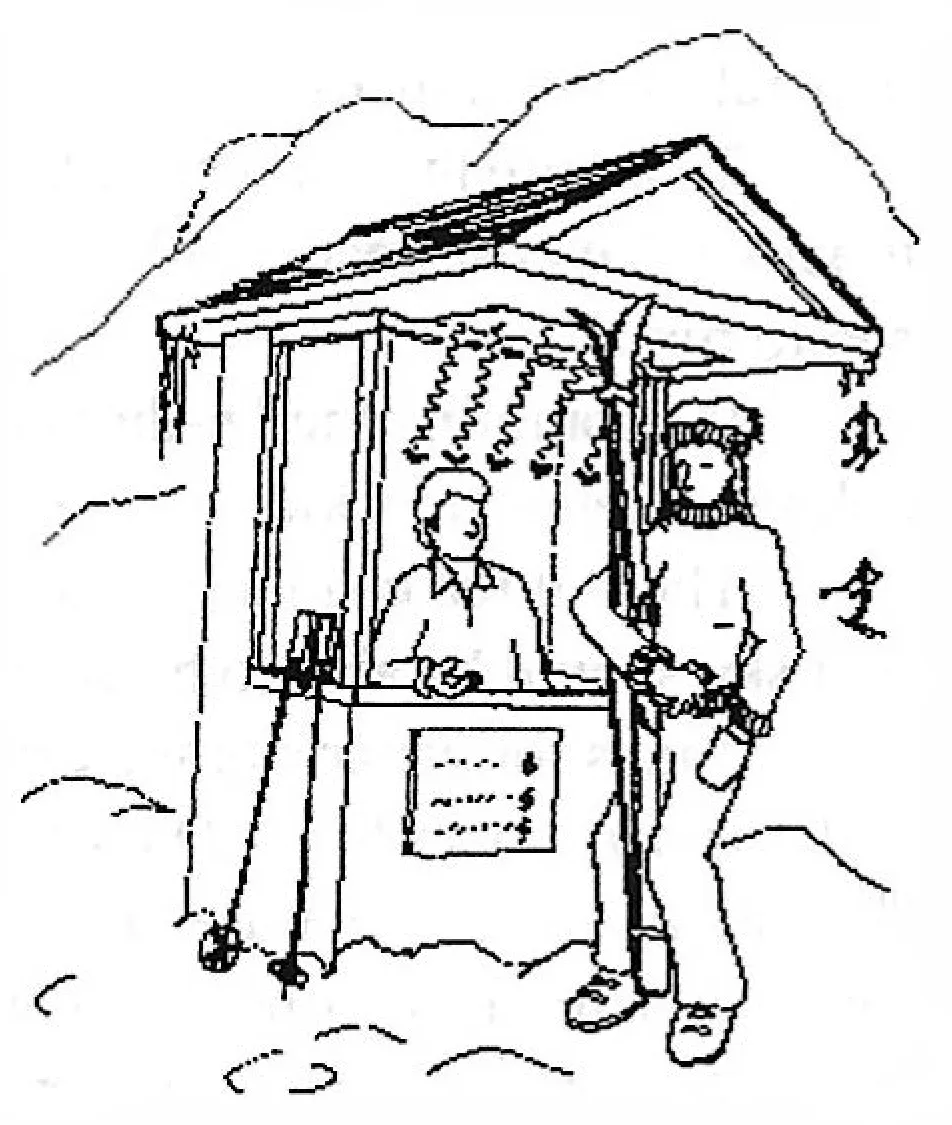
Fig. 9.8 — Small, high-temperature infrared heat sources with focusing reflectors beam heat precisely where needed. (Ed Allen, How Buildings Work, Oxford, 1995)
Zomeworks’ prototype combines radiator and storage overhead with shutters to control radiant flux — “inexpensive and effective yet it is so different people may not accept it in many kinds of buildings.” The fallback: blow-molded ceiling mats with pumped warm or cool water from storage tanks.
The marketing bet
The success of the Di-thermal roof will likely depend on marketing the luxury of radiant heating and cooling as a necessity to save energy.
This is the archive’s recurring strategic insight: the physics works, but adoption depends on comfort and aesthetics, not just economics.
See also
- Nick Pine
- Bruce W. Davis
- Bruce Davis Sol-Mod House — photo gallery
- Night-sky radiative cooling
- Thermosiphon
- Shawn Buckley
- Dear shareholders
- Cool Cell architectural climate-control
- Aluminum rolled formed roof
- Thermal vision of night
- Building thermal storage
- Overhead thermal shutters
- Index
- Roof integrated solar absorbers
- Steve Baer and the double-play thermosiphon
- Unglazed solar collectors
- Evolution of the thermal vision
- The unglazed collector lineage
- The Baer House
- Baer AIA passive solar slideshow
- Night sky radiant cooling potentials in New Mexico
- Zomeworks shipping container prototype
- Independent validation of the thermal vision
- Zomeworks Corporation
- Explaining radiant energy to laypeople
- Ray Bliss — 1961 predecessor whose nocturnal radiator and rock-pile storage demonstrated the same night-sky heat rejection